Higher education has always been built on reputation. Word of mouth. Rankings. Legacy.
For decades, that was enough. A university's standing spoke for itself, and students arrived because their parents went there, their school counselor recommended it, or the brand name carried enough weight to end the conversation.
That world hasn't disappeared. But it's been joined by a new one.
🔹 A 17-year-old in Mumbai is scrolling Instagram at midnight, trying to figure out where she wants to spend the next three years of her life.
🔹 A first-generation student in Lagos is watching YouTube videos to understand what campus life actually feels like before committing to an application.
🔹 A parent in Jakarta is lurking on LinkedIn, trying to verify whether a university's placement claims are real.
These students aren't waiting for a brochure in the mail. They're forming opinions, making shortlists, and sometimes making final decisions based entirely on what they find on social media.
University social media marketing isn't replacing the traditional reasons students choose where to study. It's becoming the first place prospective students go to confirm them.
Institutions that understand this phenomenon are quietly building student recruitment pipelines through higher education social media strategies that their competitors can't see.
This guide breaks down 35 high-impact social media strategies, tactics and frameworks for universities covering everything from organic content and paid funnels to community building, crisis management, and data-driven conversion optimization, so your institution can turn social media into a real enrollment engine.
|
And beyond social media, if you want to transform your university marketing with AI, read our 10,000 word detailed playbook → AI Marketing for Universities: The Modern Playbook for Higher Education Growth in 2026 |
Let's get into it.
Social Media Is Now a Revenue & Enrollment Engine (Not a Branding Channel)
Universities often confuse attention with intent.
A post with 20,000 views that drives zero inquiries is entertainment, not marketing. The goal is to gain attention of the right prospect with intent.
Social Media In 2026 = Enrollment pipeline + Reputation engine + Retention loop
- Enrollment pipeline
- Awareness → Consideration → Application → Enrollment
- Reputation engine
- Faculty visibility
- Alumni credibility
- Academic authority
- Retention & advocacy loop
- Student pride
- Alumni re-engagement
- Parent reassurance
That’s why the 3 outcomes universities should tie their social media to:
- Applications Volume: Not just more applications, but better-fit applications.
- Quality Leads: Students who meet eligibility, have program intent and are likely to convert.
- Yield Rate (offer → enrollment): The gap between acceptance and enrollment is where universities hemorrhage money. Social plays a massive role here.
If social isn’t mapped to revenue, it’s a cost center.
The Reverse Planning Framework → Define Outcomes First, Content Later
More often than not university marketing meetings start with the same question → “What should we post this week?”
That’s a problem. Because that question assumes content is the starting point. It’s not.
Content is the byproduct… The goal is to fix the problems and gaps in enrolment, student retention and branding.
So instead, the question you should start with → "What metric do we need to move this month?"
This is where The Reverse Planning Framework is super helpful.
The Reverse Planning Framework = Outcome → Signal → Content → Platform → Metric
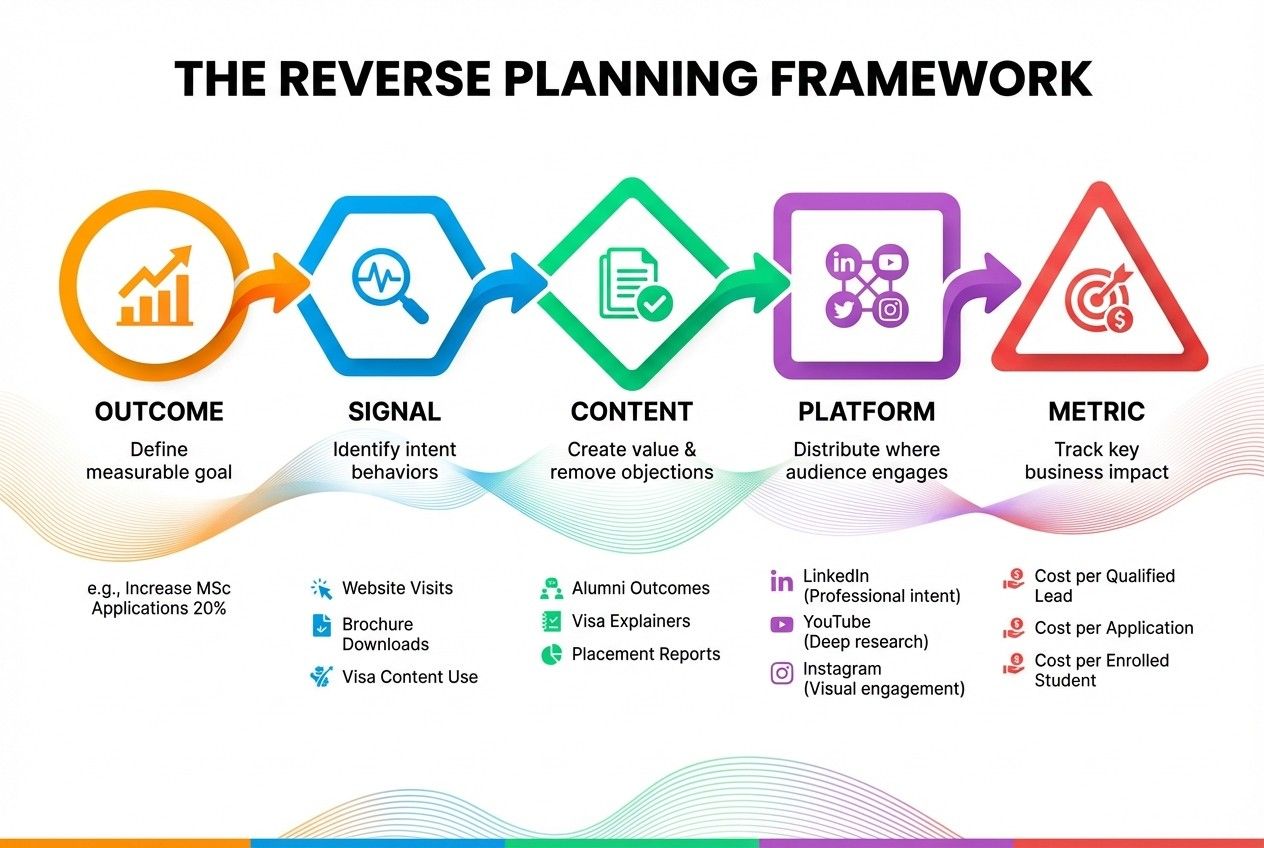
🔹 Outcome: Something that moves the institution forward in a measurable way like increase international MSc applications by 20%
🔹 Signal: Applications don’t magically appear. They are preceded by signals. Signals are behaviors that indicate rising intent. Like:
- Website visits to the program page
- brochure downloads
- Visa-related content consumption
🔹 Content: Content’s goal is to remove objections of students and parents and do so in a way that provides value while holding their attention.
- Alumni career outcomes
- Visa/work permit explainers
- Placement report
🔹 Platform: Platform choice is your distribution logic. It’s not based on one person’s preference, nor on trends. It follows your audience’s behavior and engagement patterns. You go where your audience is.
- LinkedIn – Professional intent + job trajectory conversations
- YouTube – Long-form research behavior (high-intent viewers)
- Instagram – Short form visual content
🔹 Metric: Stop chasing vanity metrics. If your outcome is increasing MSc applications, then your key metric is – Cost per qualified lead or Cost per Application or Cost per Enrolled Student (not cost per click).
Now that you have a structured way to generate content ideas, the next step is to tie them to your content pillars so every piece of content has a purpose.
Building Content Pillars For Social Media Marketing
Ask a university marketing team what they're posting next month and they'll show you a content calendar. Ask them WHY they're posting it and the room goes quiet.
Without a clear framework to decide what gets created and why, content becomes a guessing game. You post what feels right, hope something lands, and repeat the cycle next month with no clearer sense of direction than you had before.
Content pillars fix this.
Every single post your university publishes should be mapped to one of the 5 content pillars below, otherwise it shouldn’t exist.
#1 – Social Proof – Build Trust Before You Ask for Commitment
Choosing a university is a high-risk decision. So when risk is high, people look for proof. Social proof reduces uncertainty.
What falls under social proof?
- Alumni success stories (with specificity, not fluff)
- Student testimonials (real voice, not scripted marketing lines)
- Faculty credentials and industry experience
- Rankings (contextualized, not just posted)
- Industry partnerships (with actual outcomes)
- Awards, grants, recognitions
- Media mentions
- Research breakthroughs translated for non-academics
#2 – Outcome Evidence – Prove ROI
Education is an emotional decision wrapped around a financial calculation.
Parents are thinking about ROI. Students are thinking about their identity. Outcome evidence bridges both.
This is where most institutions underperform because they either:
- Hide their placement numbers
- Inflate them
- Or bury them in PDFs
In a comparison-driven world, ambiguity kills trust.
What counts as outcome evidence?
- Placement statistics (transparent, year-wise)
- Median and average salary data
- Top recruiter lists
- Career progression timelines
- Alumni promotions after 3–5 years
- Internship pipelines
- Global placements
- Entrepreneurial outcomes
- Higher study acceptance rates
#3 – Experience Validation – Show, Don’t Tell
One of the simplest mistakes universities make is they describe their campus, instead of demonstrating it.
Students want to see the hostel at midnight, coding club in action, cafeteria during finals week, placement cell hustle and so on.
This is validation content that answers → “Can I see myself here?”
What falls under experience validation?
- Campus walkthroughs (not cinematic ads but actual, real tours)
- Student takeovers
- Day-in-the-life content
- Behind-the-scenes classroom footage
- Club culture highlights
- Event coverage (in real time, not 3 weeks later)
- Faculty teaching snippets
- Peer interactions
#4 – Objection Handling – Answer Before They Ask
Every prospect has silent objections and they won’t necessarily DM you and ask. It’s your responsibility to answer those questions proactively.
Common objections to address:
- Can I afford this?
- What if I don’t get placed?
- Is this degree recognized?
- Will I fit in?
- Is this program too hard?
- What’s the visa situation?
- How does this compare to XYZ college?
#5 – Urgency Creation – Drive Action
Leveraging urgency is an art. Most universities either create artificial urgency or fail to create any urgency at all.
What they don’t realize is that deadlines alone don’t drive action. Consequences do. And pairing urgency with consequences creates a deadly combo.
Try this – instead of saying “Applications close in 3 days.” say:
“Applications close in 3 days. Last year, 18% of applicants missed scholarship eligibility because they applied late.”
What counts as urgency content?
- Application deadlines (with reminders)
- Scholarship window countdowns
- Limited seat notifications
- Early decision advantages
- Event registration closing
- “Final campus visit day” posts
What Not to Post
Most content calendars are bloated. Stop posting:
- Generic motivational quotes
- Random national days unrelated to your mission
- Repetitive festival greetings
- Faculty research PDFs without translation
- Event recaps 3 weeks after the event
- Internal committee announcements students don’t care about
- Stock photo ‘Happy Monday!’ posts
A simple way to recognise this to ask yourself → If we stopped posting this for 3 months, would enrollment drop?
If the answer is no, cut it. Attention is scarce. Don’t waste it.
12 High-Impact Social Media Strategies Every University Should Use
#1 – Student Ambassador Program
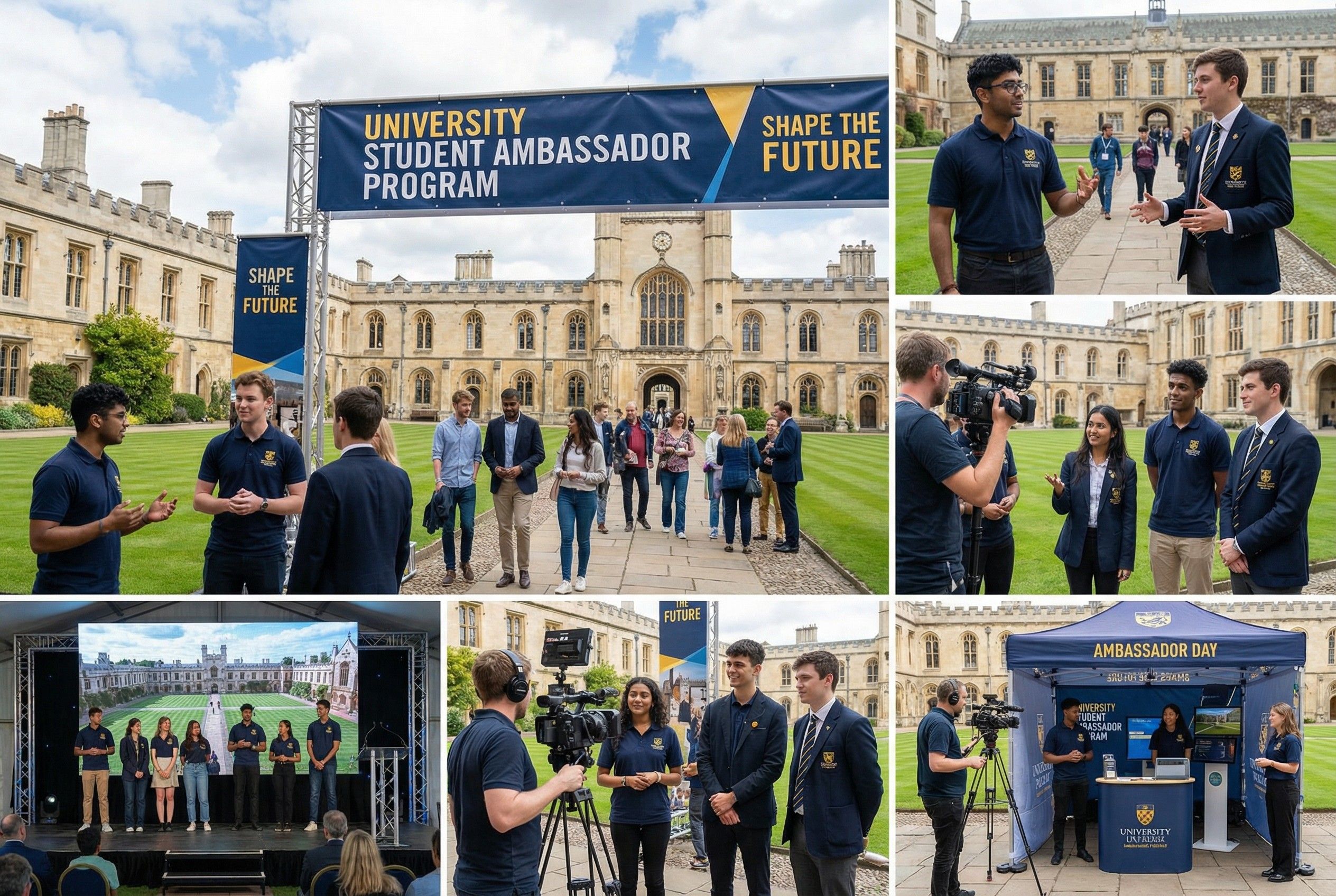
Most universities have ambassadors. But very few run ambassador programs like a media operation.
Imagine having 30-50 students posting 2x every week about your college.
That’s 240-400 posts every month.
With an average reach of 200 people per post, you’re reaching 48,000-80,000 new people every month with your student ambassador program.
But how do you build such a system and what’s required to run it?
Let’s look at how to build a Student Ambassador Program:
Step 1 – Recruit 50 students for ambassador program
Don’t just pick students from marketing majors. Open it for every student.
You want diverse view points and demographics to represent your university so recruit students from all majors.
Now to attract students, don’t position it as an ambassador program, instead position it as a social media training program for students with the primary focus area being university marketing.
Whoever completes it with the passing criteria are offered an extra academic credit or certification. This makes it super lucrative for students to join.
Step 2 – Run it like a structured training program
Run it as a disciplined program with baseline rules that disqualifies students who don’t actively participate.
- Every student needs to post 2x per week
- Weekly 60-minute live sessions covering best practices, and real-world examples
- A dedicated WhatsApp group where students share ideas, give feedback, and collaborate
Another problem you’ll face is the students’ friction to get started. After all, not everyone feels comfortable posting on social media. Eliminate this friction by providing them:
- A bank of content themes they can pick from. Like academic life, local area guides, program-specific insights, day-in-the-life, study tips, etc
- Angles for each theme so students can use what fits their style the best
- Copywriting and storytelling frameworks to use
- Training on how to use AI tools to generate authentic content
- Posting guidelines on tone, brand safety and compliance
Step 3 – Build engagement loops and recognition systems
Incentivizing and engaging students goes a long way in the success of your Ambassador program. It increases both accountability and quality of outcome.
Offer incentives like:
- $300–$600 per semester stipend
- Academic credit
- Resume-building certificate
- LinkedIn endorsements from the university
- Portfolio feature on official website
- Priority access to events
Then go a step further and introduce performance-based bonuses:
- $50 bonus for Reel crossing 25k views
- $25 bonus for most saves in a month
- Make a big deal of the winners so others get inspired to do the same
Create a shared leaderboard tracking weekly posting consistency for everyone to see. Keep cranking up the gamification engine, it drives creativity.
#2 – Student Takeover Strategy
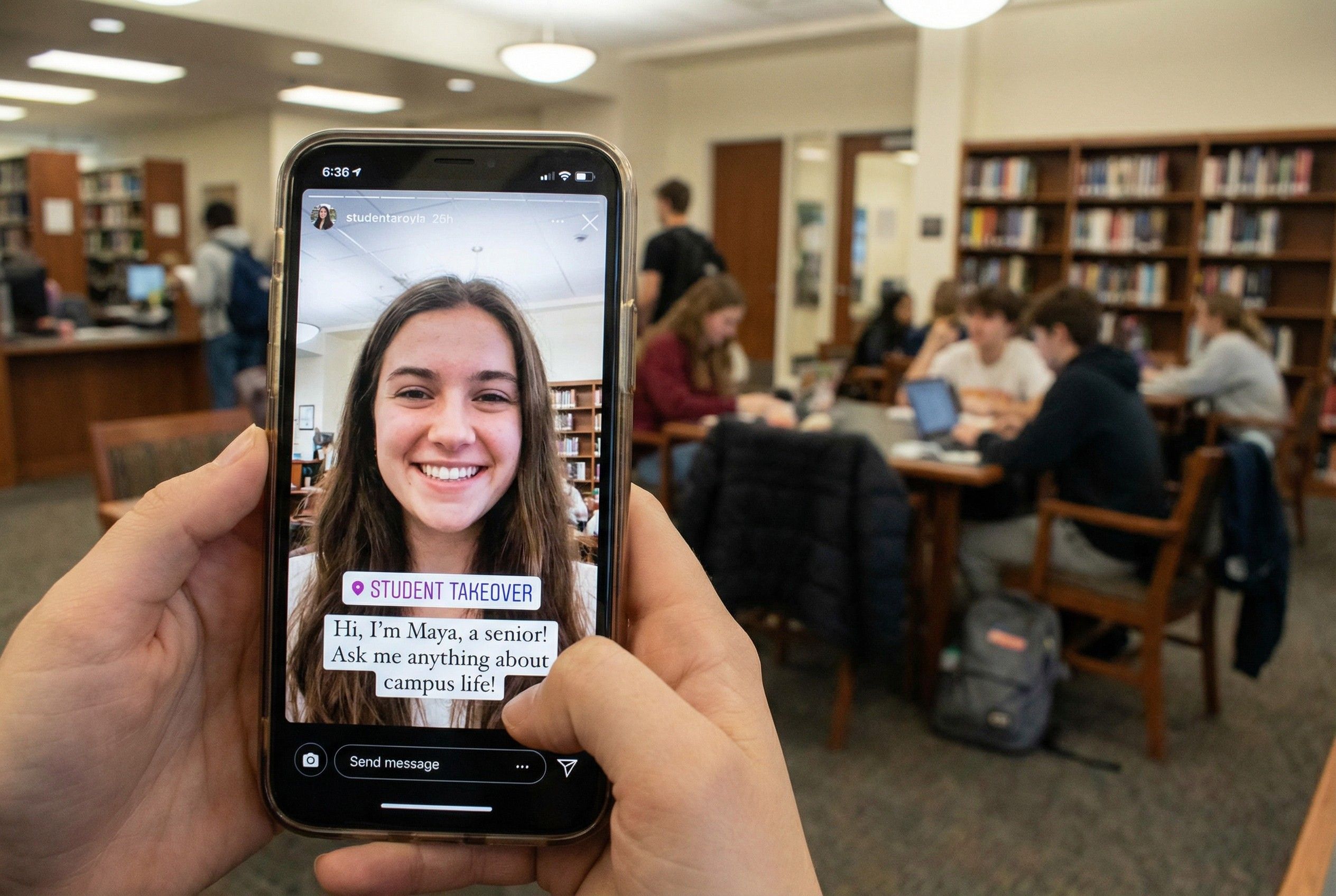
Takeovers are one of the highest-trust formats on platforms like Instagram and TikTok. They’re authentic, real and perfect for driving conversions.
The core idea is to give students 24-hour access to Instagram Stories during key moments that are emotionally loaded and visually rich.
Examples:
- First day of classes
- Move-in day
- Finals week
- Game day
- Club fair
- Research presentation day
- Internship acceptance day
- Graduation day
It’s not that you’re handing over complete control of your University Instagram or Tiktok page to students, you merely post their content. University team is still in complete control.
To ensure it works smoothly, you need to provide students with:
- Possible story angles to take
- Shot list
- Suggested story structure
- Engagement prompts
- Hashtags
- Poll ideas
- Q&A sticker suggestions
The goal is to provide enough supporting material and guardrails that students can focus on creating the most engaging stories.
Lastly, use Takeovers for enrollment conversion. During takeovers:
- Include “Ask me anything about applying”
- Add link sticker to application page
- Collect common questions
- Use responses for FAQ content later
#3 – Identify Micro-Influencers: Scale Trust Through Students Who Already Have Reach
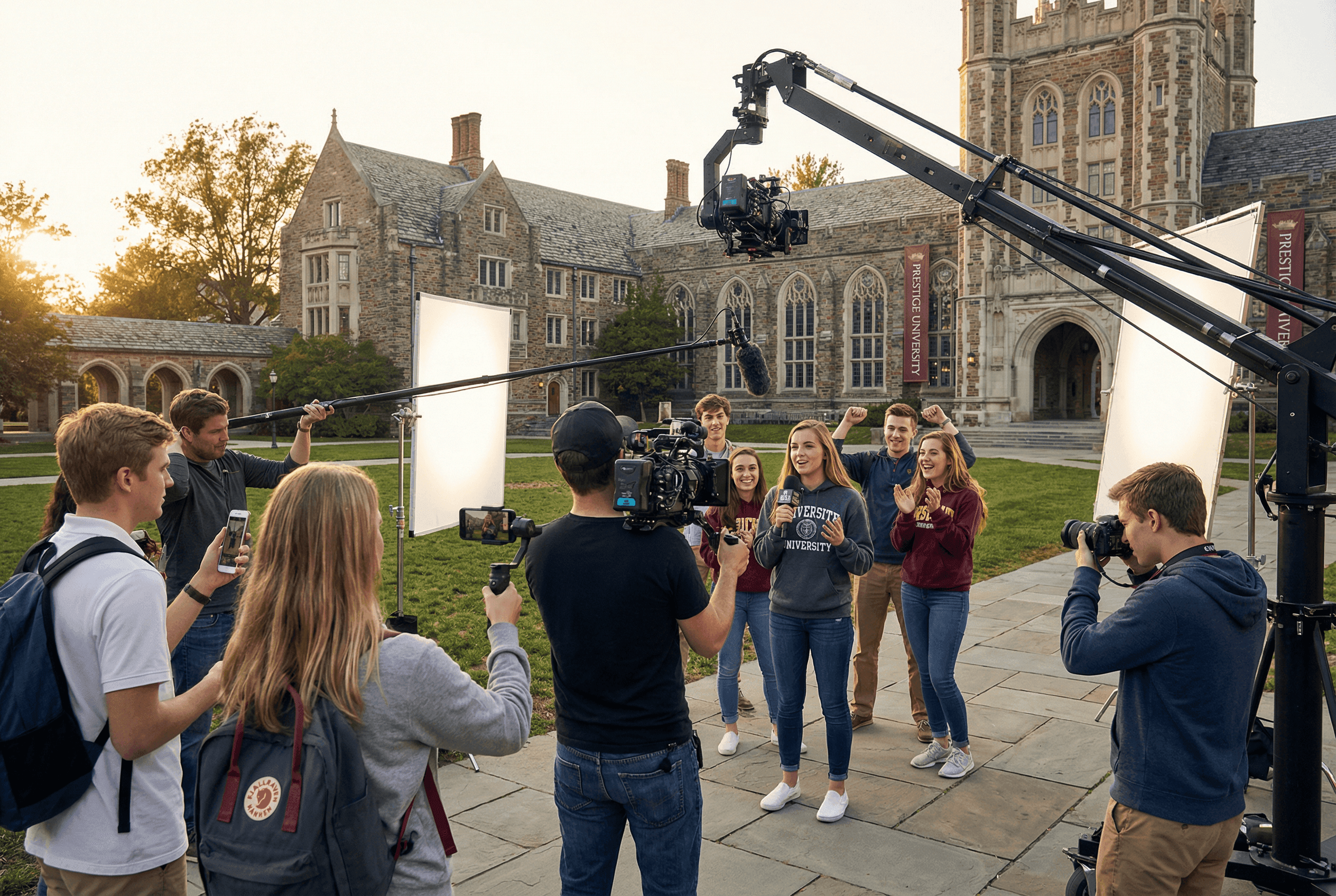
You don’t need celebrity influencers to promote your university. You need credible campus voices → students with 1,000–10,000 followers.
They have a tight knit community around them, have strong peer influence and their posts usually show high engagement rates.
Step 1 – Use social listening tools to find micro influencers
Search for:
- University hashtags
- Dorm names
- Mascot mentions
- City name + student life
- Campus event tags
Use tools like Brandwatch, Sprout Social and actively monitor students posting about their study routines, campus vlogs, sports content, outfit-of-the-day on campus and so on.
Step 2 – Go beyond the follower count
Evaluate:
- Engagement rate (aim 4–8%+)
- Comments quality
- Audience demographics
- Content consistency
- Authentic tone
A micro-influencer with 2k followers may have more engagement than one with 20k followers. Don’t overlook that.
Step 3 – Formalize the relationship
Instead of random reposting, turn them into “Campus Creator Partners”
- Provide exclusive access (behind-the-scenes, early event entry)
- Give small stipend or event perks
- Offer cross-promotion on official channels
Partner with 20 Campus Creators and see your social media game graduate to the next level within one quarter.
#4 – Research Translation Strategy
Most universities post their research in this boring manner…
Avoid this. Instead, take your faculty publications and translate them into multiple pieces of content:
- 60-second TikTok explainer
- Carousel post with 5-7 key findings
- Instagram Reel with faculty interview
- LinkedIn article with implications
The goal here is to explain the research in plain english so even a high school student can understand its implications.
#5 – Faculty Thought Leadership
Your professors and faculty aren’t short on ideas. They’re short on time.
Every week, they’re generating insights in classrooms, labs, conferences, and advisory boards that would make for powerful LinkedIn content. But they don't know what to post, and feel awkward about self-promotion.
This is where Gen AI can be invaluable. Here are 2 strategies you can choose from:
Strategy 1: Give them ChatGPT prompts that turn their idea and expertise into LinkedIn content in 60 seconds.
Strategy 2: Give them a custom GPT that’s trained on your brand voice, language and color theme. It generates 150-word posts in an engaging way that doesn’t sound like it’s AI-generated.
The professor edits the outcome for factual accuracy, nuance, and publishes it through their social media.
This way you’ve reduced their cognitive load from ‘write something thoughtful’ to ‘refine something useful.’
But don’t stop here. Run quarterly workshops teaching faculty how to share their work on social, this knowledge compounding goes a long way.
|
Want To Build A Custom GPT Trained On Your University’s Brand Voice? This is what we do for brands. Talk to us and find how how quickly we can build it for you. |
#6 – Build Content Featuring The Faculty
You already pay for world-class expertise, fascinating research and passionate educators.
All you need to do is put a camera in front of them – strategically.
You can create low-cost, highly credible content of your faculty thinking out loud, answering questions, reacting to real-world developments.
🔹 "Ask a Professor" Live Q&A Series
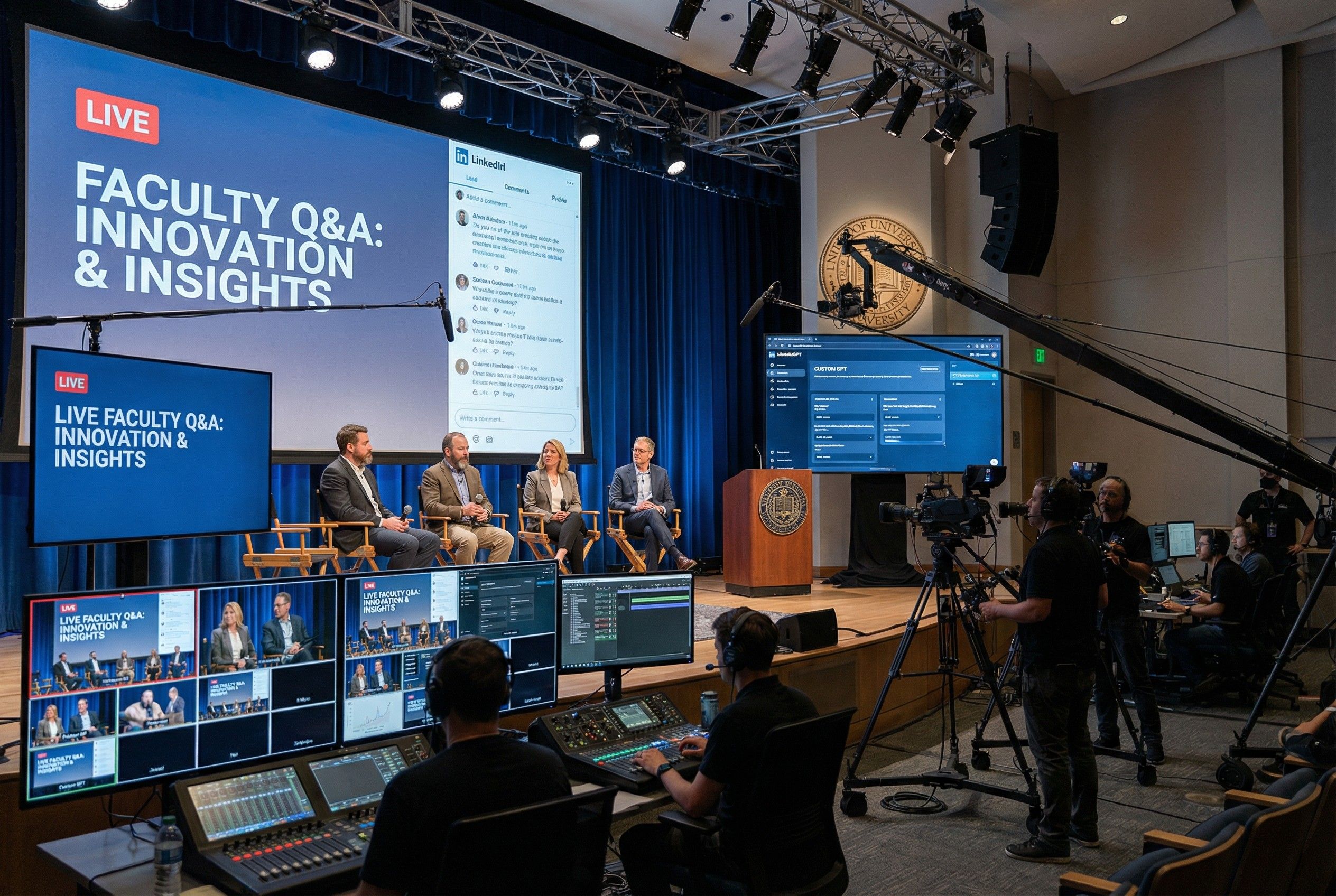
Instead of static faculty bios on your website, create recurring live sessions where professors speak directly to students, parents, alumni, and industry professionals.
This builds parasocial relationships (people feel connected to the professor) and lowers intimidation barriers. But more importantly, it signals academic depth without sounding promotional.
A high school student choosing between two universities will remember the one where they interacted live with a professor.
Stream the session live on multiple platforms – Instagram Live, Linkedin Live, Youtube Live.
🔹 Lab Live Streams & Research in Action
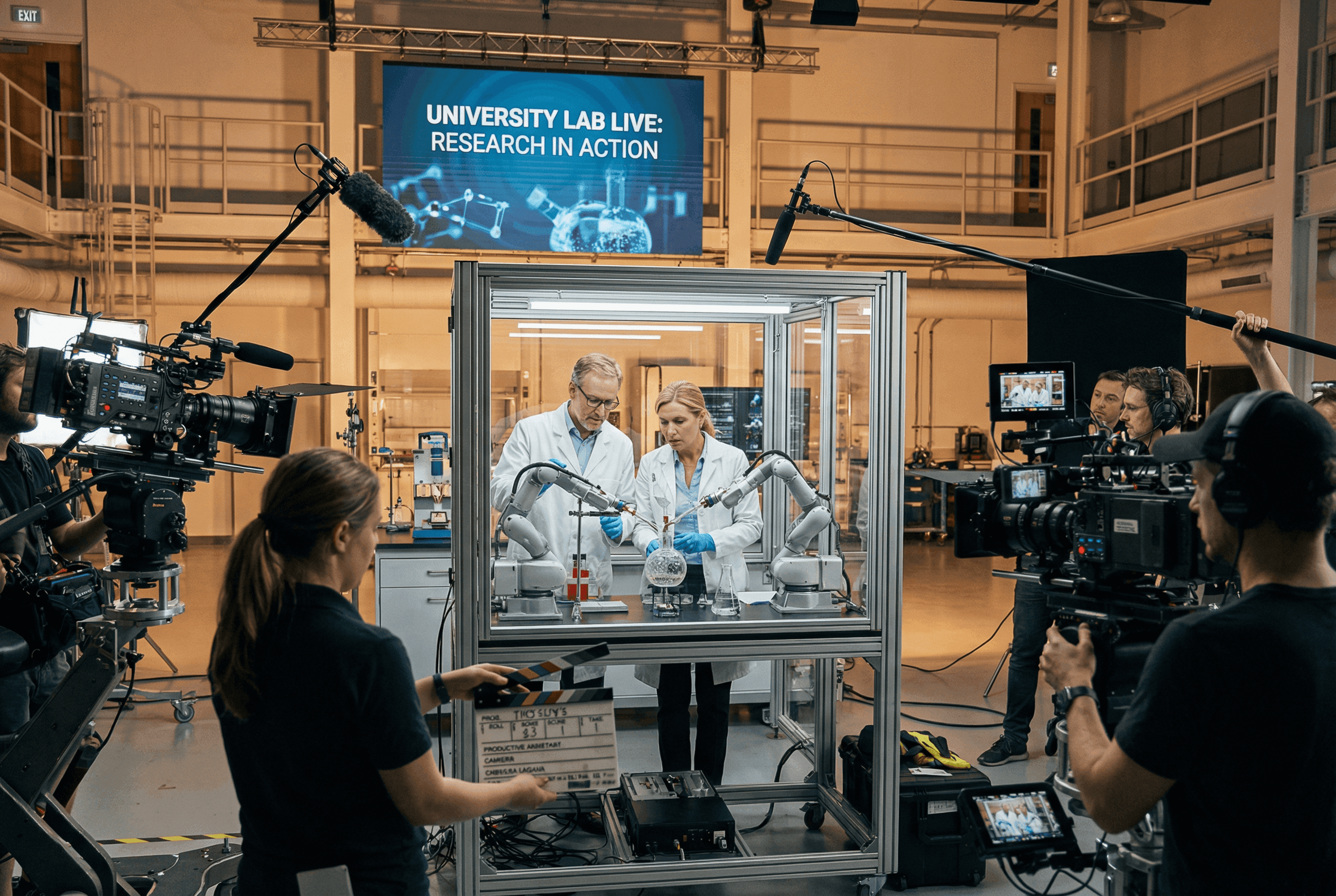
These type of live streams build credibility and excitement. After all, there’s something powerful about seeing research happen in real time.
Instead of polished lab tours, show the real thing:
- Setting up an experiment
- Running simulations
- Testing prototypes
- Field research prep
This makes research tangible. It signals to prospects that your university invests in real innovation and students get hands-on exposure.
🔹 Faculty Commentary on Current Events
Another powerful, low-effort activity is to have professors react to trending news in their field. Examples:
- AI regulation updates
- Economic shifts
- Public health developments
- Legal rulings
Film a 60–90 second reaction explaining what people are missing and why students should care.
This positions your university as intellectually relevant and the one that keeps up in real time.
#7 – Alumni Engagement & Storytelling Loop
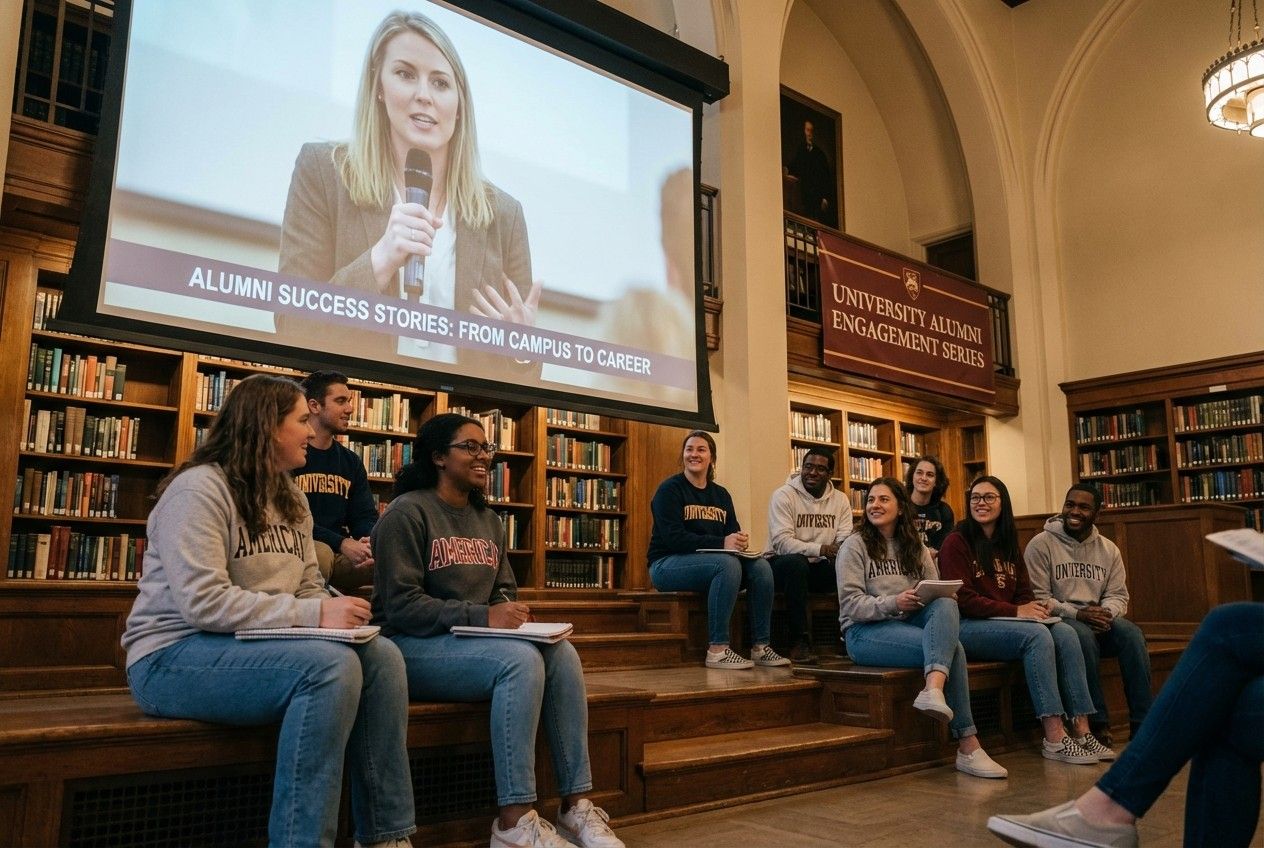
Your alumni are your walking, talking case studies and yet universities treat them like an abandoned mailing list.
Universities need to treat alumni like a media channel. They are a living proof of ROI. And they remind prospective students – ‘Look what happens when you start here.’
🔹 Career Path Visualization Content
Instead of one-off alumni features, build series that show career trajectories.
- 5 Alumni, 5 Careers in Data Science
- Where Our Economics Graduates Work
- What You Can Do With a Political Science Degree
Then repackage the content into LinkedIn carousels, Instagram highlight reels, YouTube shorts, Data-driven infographics and multiple other formats.
🔹 Alumni-Led Micro Mentorship on Social
Create videos of alumni sharing their experience, expertise or advice.
- Alumni answering 3 rapid-fire career questions on Instagram Stories
- LinkedIn Live with alumni discussing industry trends
- “Ask Me Anything” with a recent graduate
This creates intergenerational community which is incredibly powerful for brand loyalty.
🔹 Reunion & Homecoming as Social Events
Don’t treat them as just physical events. When alumni return to campus:
- Capture reaction videos
- Film “Then vs Now” moments
- Recreate old campus photos
- Interview them in front of meaningful campus locations
Nostalgia performs extremely well on social. It strengthens emotional attachment which increases engagement, referals and donations.
🔹 Leverage Alumni in Admissions Marketing
Use alumni in:
- Paid ad testimonials
- Application season campaigns
- Landing page videos
- Email nurture sequences
Instead of saying – “Our program prepares you for leadership.”
Show them – “Here’s a graduate leading at X company.”
Proof > claims.
#8 – Paid Social Strategy
Most universities think in campaigns when they should be thinking in funnels.
A one-off "Apply Now" ad only converts students who are already at the finish line. The vast majority of your prospective students need to be warmed up, nurtured, and guided. And paid social is the engine that moves them through that journey.
For this, you can design a 3-layer paid funnel. Every pound or dollar you spend should map to one of three funnel stages:
Top of Funnel (Awareness)
Reach students who've never heard of you. The goal here isn't conversion, it's attention.
- Use broad interest targeting, video content, and storytelling ads that introduce your institution's personality, campus culture, and outcomes.
- Metrics to watch: video views, reach, and cost-per-thousand impressions.
Middle of Funnel (Consideration)
Target students who've engaged with your content or visited your site.
- You can go deeper into program-specific content, student testimonials, virtual campus tours, and webinar invites. The goal is to build enough trust and curiosity to capture a lead.
Bottom of Funnel (Conversion)
These students know you. They may have downloaded a brochure, started an application, or attended an open day.
- Hit them with urgency like deadline reminders, scholarship windows closing, one-to-one enquiry prompts.
- Your messaging here should feel personal, not broadcast.
Treating these three layers as a single campaign is where most university paid strategies fall apart.
🔹 Intelligent Retargeting
Retargeting is where enrollment budgets quietly win or silently bleed. The success factor here is specificity.
Blasting the same ad to everyone who ever visited your website is a waste. Instead, build layered retargeting audiences based on behaviour:
- 7-day website visitors
- 30-day visitors
- 90-day visitors
- Video viewers segmented by completion percentage (25%, 50%, 75%, 100%)
- Brochure or guide downloaders
- Webinar registrants who didn't attend
- Application starters who didn't submit
Then tailor your messaging for each segment. A student who visited your site 30 days ago needs a different message than one who started an application yesterday.
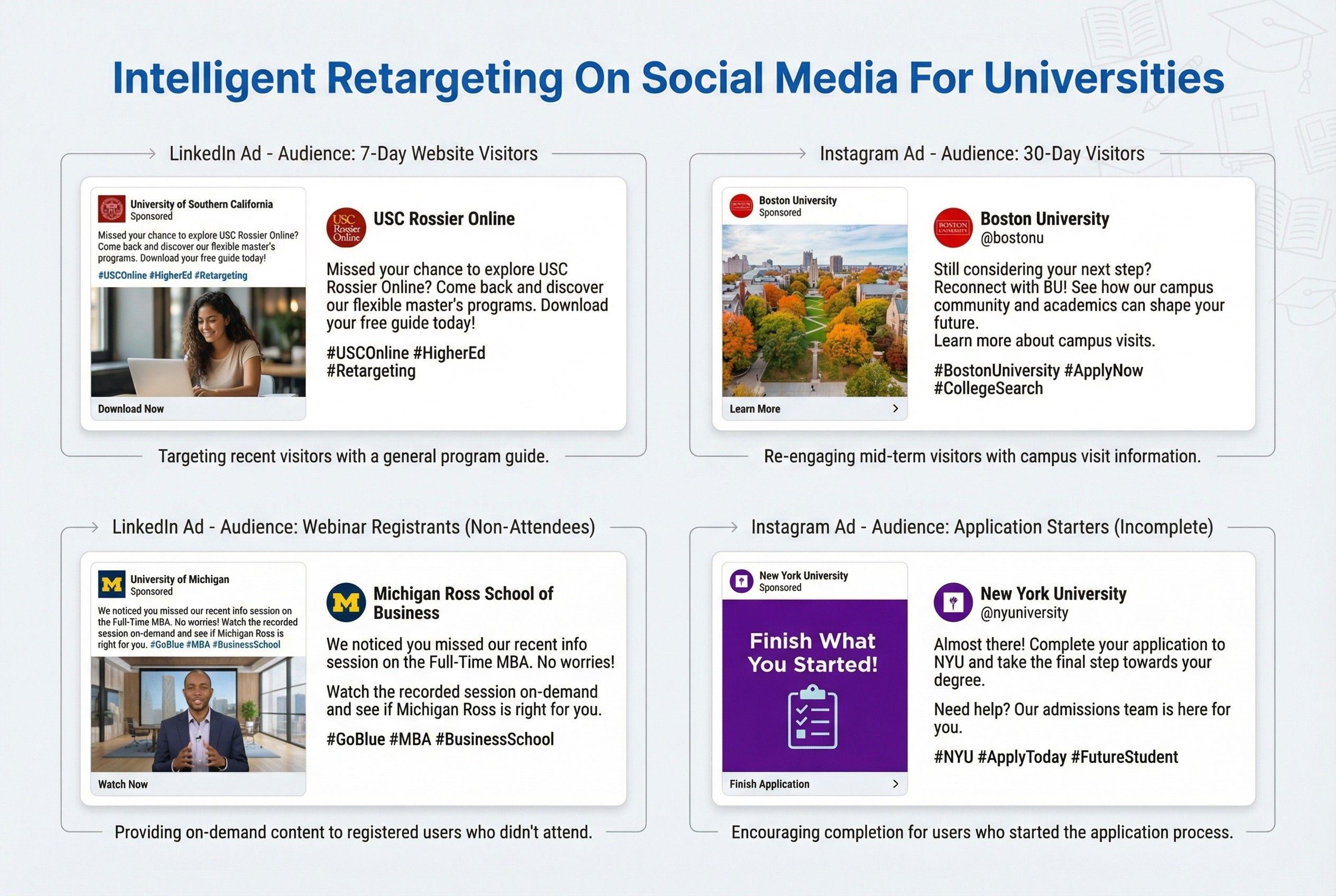
For example: a 30-day visitor might see → "Still exploring your options? Here's what sets us apart." An application starter gets → "You're almost there. Deadline closes in 5 days."
The most powerful format here is a behaviour-triggered ad sequence. Map it like this:
Video view → Serve brochure ad → Brochure download → Serve webinar invite → Webinar attendee → Serve application push → Application started → Deadline reminder
This kind of sequencing feels relevant to the student and dramatically improves conversion efficiency.
For advanced targeting, build lookalike audiences modelled on your enrolled students, scholarship winners, and high-performing applicants.
🔹 Invest in Lead Magnets
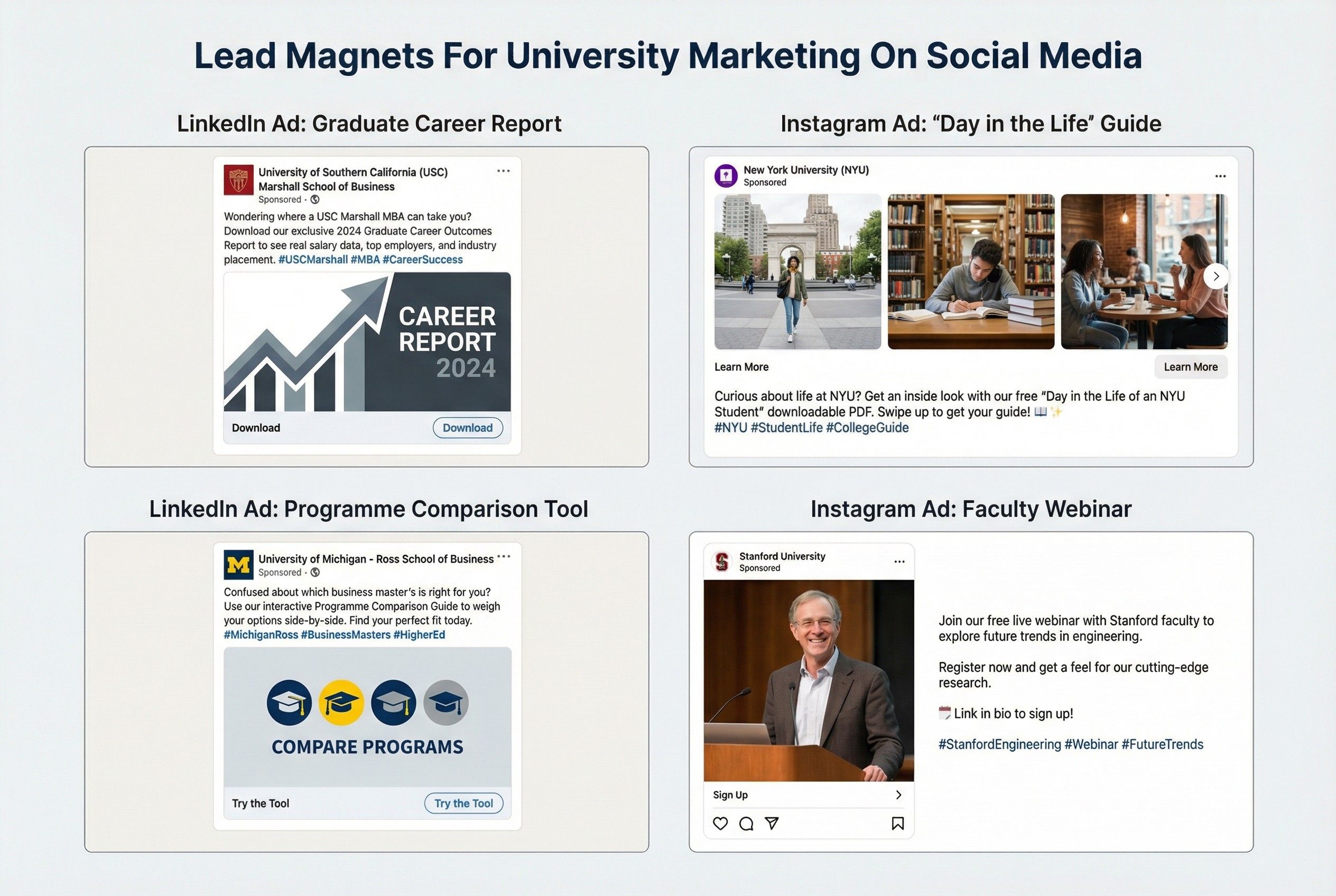
Cold prospects rarely apply on first contact. Asking someone who's never heard of your MBA programme to submit a full application is the equivalent of proposing on a first date.
Instead, offer something genuinely useful in exchange for an email address:
- Programme Comparison Guide
- Graduate Career Outcomes Report
- ‘Scholarship Finder’ tool or guide
- ‘Day in the Life’ downloadable PDF
- A free webinar with faculty or alumni
- A campus visit booking incentive
When you capture an email, you own that relationship beyond the paid click.
You can nurture them through email, retarget them as a known lead, and track their journey through your CRM.
🔹 Use Paid Budget to Amplify Organic Winners
When a Reel gets unusually high saves, a student testimonial is driving strong comments, or a faculty clip is sparking shares – those are signals. Leverage them but putting paid ad budget behind them.
You've already de-risked the creative by testing it for free. Now you're scaling what you know works.
This organic-to-paid flywheel reduces creative risk, increases efficiency, and means your ads don't feel like ads because they started as genuine content that real people responded to.
#9 – Event-Jacking & Newsjacking Framework
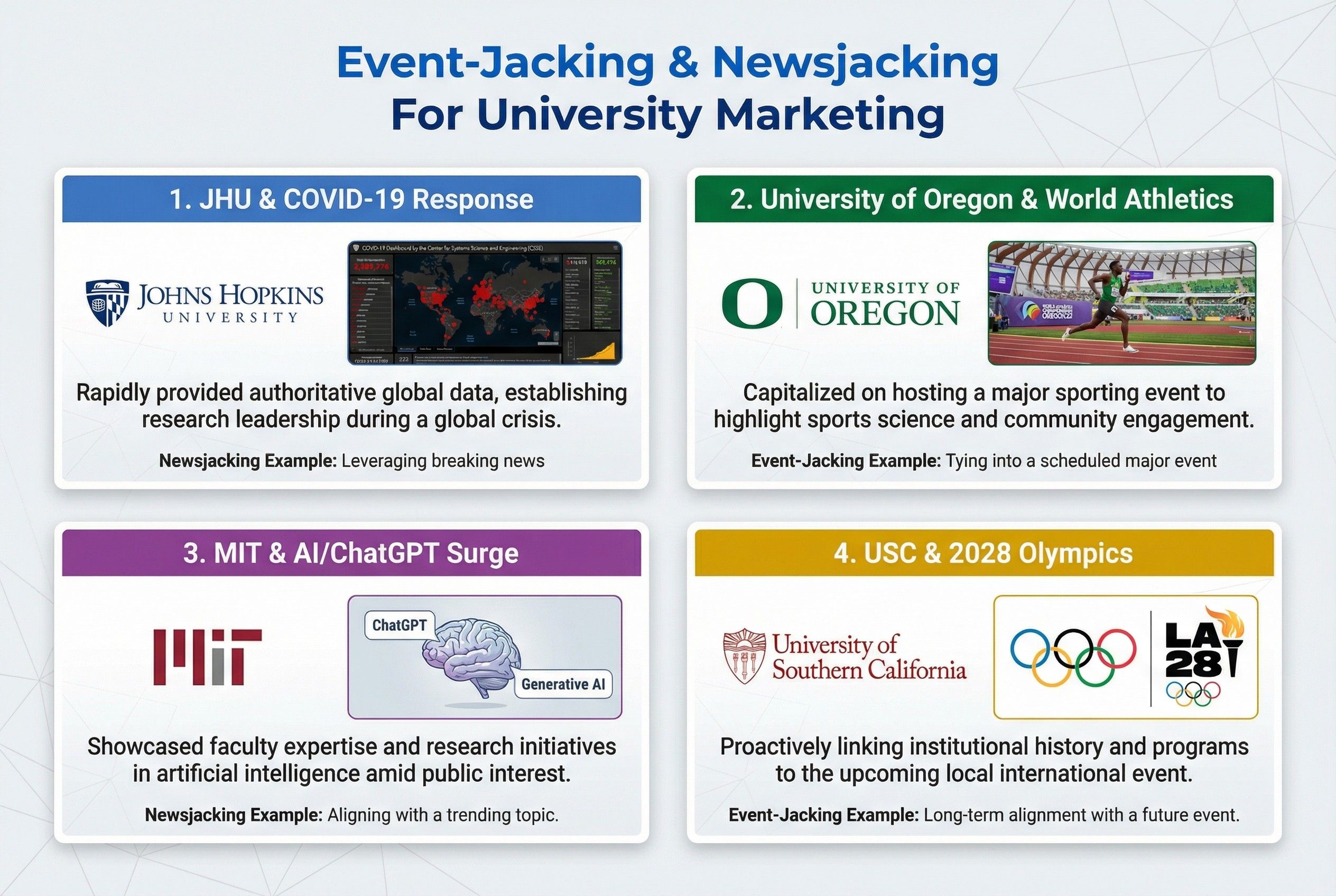
Most university social media teams operate on a 2-week content approval cycle.
The internet moves in 48 hours.
By the time your carefully designed post about a trending moment gets approved, scheduled, and published – the moment is dead. The algorithm has moved on. Your audience has moved on.
The universities winning on social media have built systems that make speed possible without sacrificing quality or brand safety. Here's the full playbook…
🔹 Faculty Rapid Reaction Content
When industry news breaks like a major company collapse, a policy shift, a market disruption – your faculty have something no news outlet or influencer has: academic depth and institutional credibility.
The window to use it is 3–6 hours after the news drops. After that, the discourse is already crowded.
Build a standing protocol where your rapid response team immediately identifies which faculty member is most relevant to the news, reaches them within 30 minutes, films a 60–90 second reaction, edits it on-site, and publishes it the same day.
Frame it like media does → "What an economist from [University] thinks about the Fed rate cut" or "Our AI professor reacts to OpenAI's latest announcement."
This positions your faculty as the go-to commentators your audience actually wants to follow. Over time, this builds a media identity for your institution that no paid ad campaign can replicate.
🔹 The "What This Means For Your Career" Content Format
Every major industry news event is a recruitment moment in disguise. You just need to make the connection explicit.
When a Big 4 firm announces mass layoffs, your finance faculty should be on camera within hours explaining what this means for students entering the industry.
When a new regulation hits the healthcare sector, your public health program leads the conversation and discusses its impact.
This format works because it feels useful, not promotional. But it quietly does a very specific job → it pulls in high-intent prospective students who are actively researching whether a particular career path is worth pursuing.
The student watching your "What AI regulation means for software engineers in 2026" video is exactly the kind of student you want.
Create a recurring series around this format. Give it a name. Give it a visual identity. Post it consistently. Within 2-3 months, you'll have a content franchise and a massive audience that keeps coming back.
🔹 Engage the Negative Discourse, Don’t Dodge It
Every few months, a narrative goes viral on TikTok or Twitter about the broken state of higher education. Student debt is crushing graduates. Degrees are useless. Universities are scamming young people.
Most institutions react in one of two ways – they ignore it, or they quietly panic.
The right move is to engage directly.
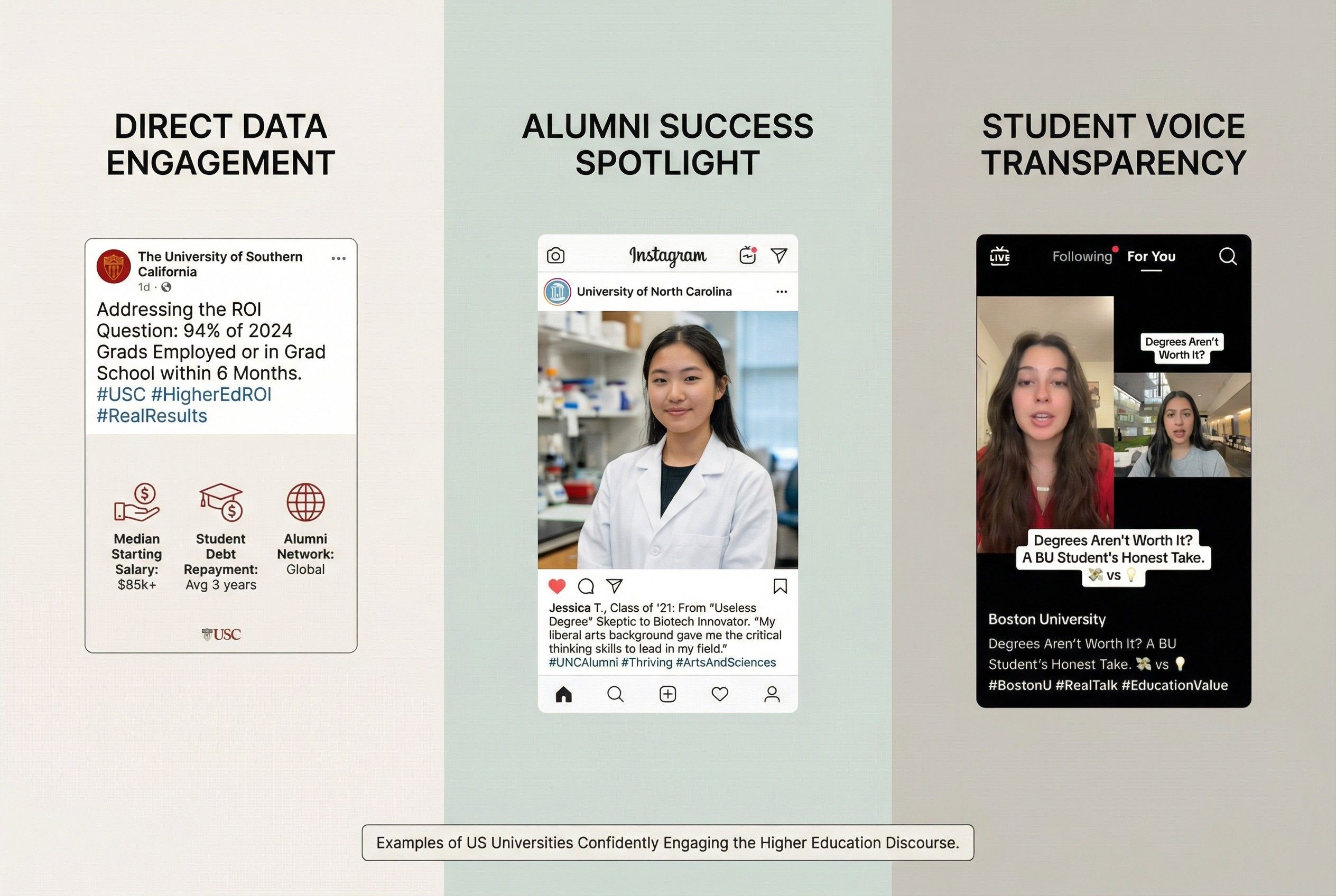
When a negative trend is dominating the discourse, create content that addresses it head-on. Not defensively, but confidently. Show your placement numbers. Feature alumni who are thriving. Break down ROI transparently. Let your students speak.
"Everyone's saying degrees aren't worth it. Here's what our 2024 graduates are actually doing."
The institutions that engage the skepticism build the most trust. Silence reads as guilt. Direct engagement reads as confidence. And confidence converts.
🔹 Predictive Content Calendar With Pre-Built Templates
Not all speed requires reaction. Some of your biggest content opportunities happen on the exact same date every single year.
First day of classes. Finals week. Graduation. Results day. First snow. Move-in day. These moments are never a surprise.
Leverage them by pre-building everything 90 days out. Design the visual format, write the caption framework, prep the B-roll shot list, and identify which student ambassadors will cover it – before the moment arrives. When it hits, you're executing, not ideating under pressure.
🔹 Build a Campus Content Intelligence Network
Your content team can't be everywhere. But your students, faculty, and staff are everywhere, all the time.
Turn your entire campus into a content tip network. Create a private WhatsApp or Slack channel where anyone – students, professors, admin staff, coaching staff can submit ‘things happening right now.’
A student just received an offer from McKinsey. A lab just achieved a research breakthrough. A spontaneous protest just broke out. The placement cell is going wild because 12 students got offers in one afternoon.
Your content team monitors this channel and decides within minutes what deserves immediate coverage.
This does two powerful things:
- First, it gives you a constant feed of real, authentic, emotionally charged moments that no content calendar could predict.
- Second, it builds a culture where the whole campus sees itself as part of the institution's story, which deepens pride, community, and retention.
#10 – Community Building & Engagement Loops
🔹 Build Private Communities for High-Intent Audiences
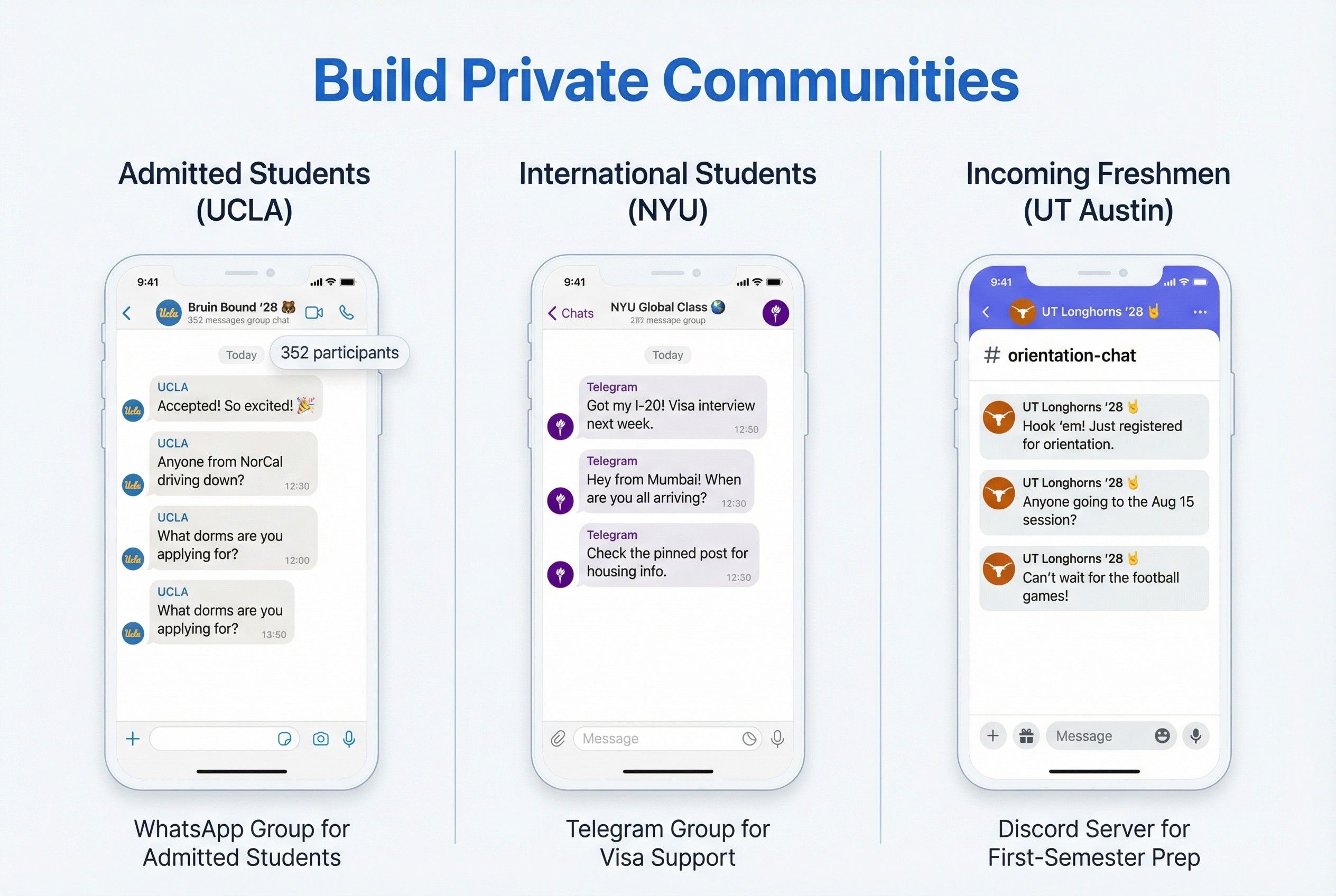
Your public social channels are for reach. But the highest-value conversations in your admissions funnel happen in more intimate and smaller groups.
Create private communities for your most important audience segments:
- admitted students waiting to make their final decision
- incoming students preparing for their first semester
- students from specific countries navigating visa processes
- alumni from specific graduation years
Think about it – a student who’s been offered enrolment and waiting to make their final decision joins a Whatsapp group of all other admitted students. They see hundreds of future classmates already excited, already connecting, already planning – the decision gets made for them.
These communities also generate an endless supply of authentic content. The questions being asked in those groups are exactly the objections you should be answering publicly. The excitement being expressed is exactly the social proof you should be amplifying.
🔹 The First-Hour Comment Response Rule
The algorithm is watching what happens in the first 60 minutes after you post.
When a post goes live, assign someone on your team to respond to every comment within the first hour. Not with generic replies like "Thanks for sharing!" but with actual responses. Ask a follow-up question. Add context. React with genuine personality. Make the person feel seen.
This does three things simultaneously.
- It signals to the algorithm that your post is generating real interaction, which dramatically expands distribution.
- It signals to commenters that there are real humans behind the account, which increases the likelihood they comment again.
- And it signals to everyone reading the comment section (including silent lurkers who are prospective students) that this institution is actually engaged with its community.
Responding to the top 20 comments is the minimum. Responding to all of them should be the ideal standard.
🔹 Turn Your Comment Section Into a Content Factory
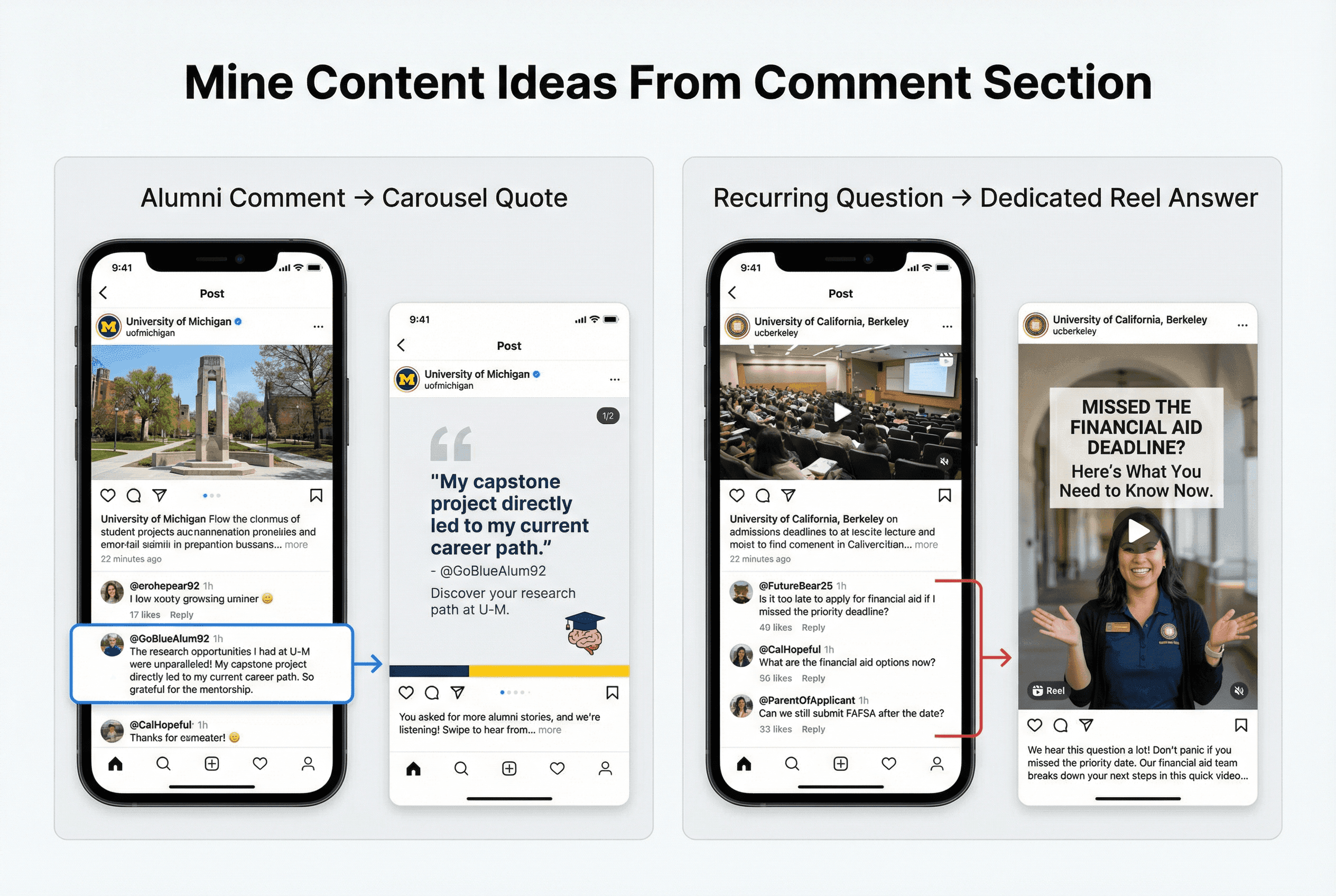
The most honest feedback about your university lives in your comment section. And most teams read it defensively instead of strategically.
Every week, pull the most interesting, insightful, or emotionally resonant comments from your posts and turn them into content.
Screenshot a particularly thoughtful alumni response and make it a carousel slide. Take a question that keeps appearing in your comments and turn it into a dedicated Reel that answers it properly.
This tells your community that their voices are actually heard and acted upon, which deepens engagement loyalty. And it solves a content ideation problem because your audience is already telling you exactly what they want to know.
🔹 Create Rituals With Your Community
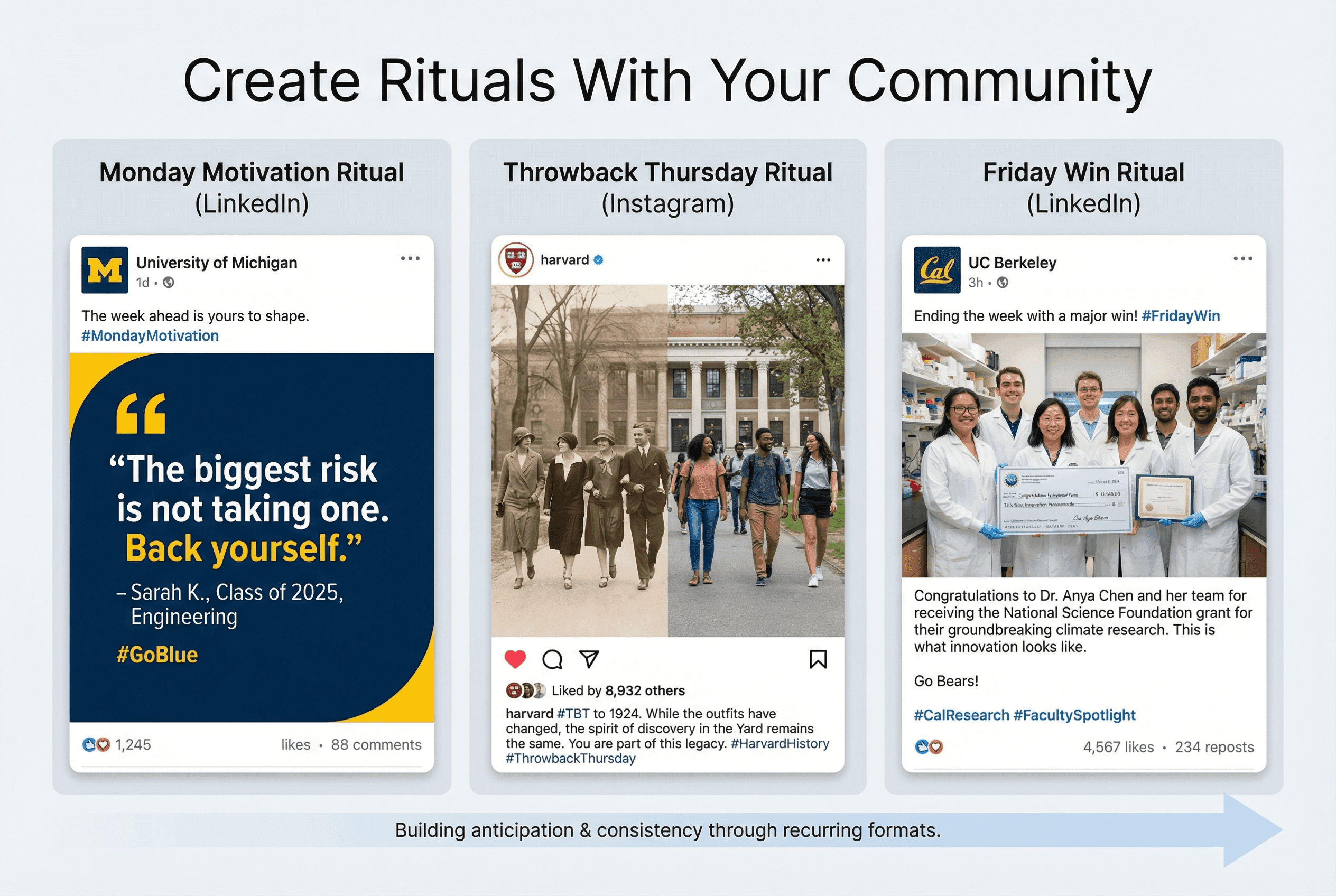
The most engaged communities on the internet like sports fandoms, gaming communities, tight-knit subreddits aren't built on content volume. They're built on rituals. Recurring formats that people look forward to, participate in, and bring their friends to.
Build 2–3 recurring social rituals your audience can count on.
- A "Monday Motivation" that features a real student quote
- A "Friday Win" that celebrates one student or faculty achievement from that week
- A "Throwback Thursday" that digs into your institution's history in a way that makes current students feel like part of something bigger
The goal is consistency and building anticipation. When your audience starts checking your page on Friday specifically to see who got featured that week, you've built something super powerful.
#11 – Crisis Prevention & Response Protocol
Every university will face a social media crisis at some point.
A student posts a viral thread about a safety incident on campus. A professor's comment gets taken out of context and starts trending. A policy change triggers student outrage. A national news story drags your institution's name into a debate you didn't start.
Most universities aren’t ready to handle situations like these.
The institutions that come out of crises with their reputation intact or even stronger don't wing it. They've rehearsed and practised.
🔹 Build a Social Listening Dashboard
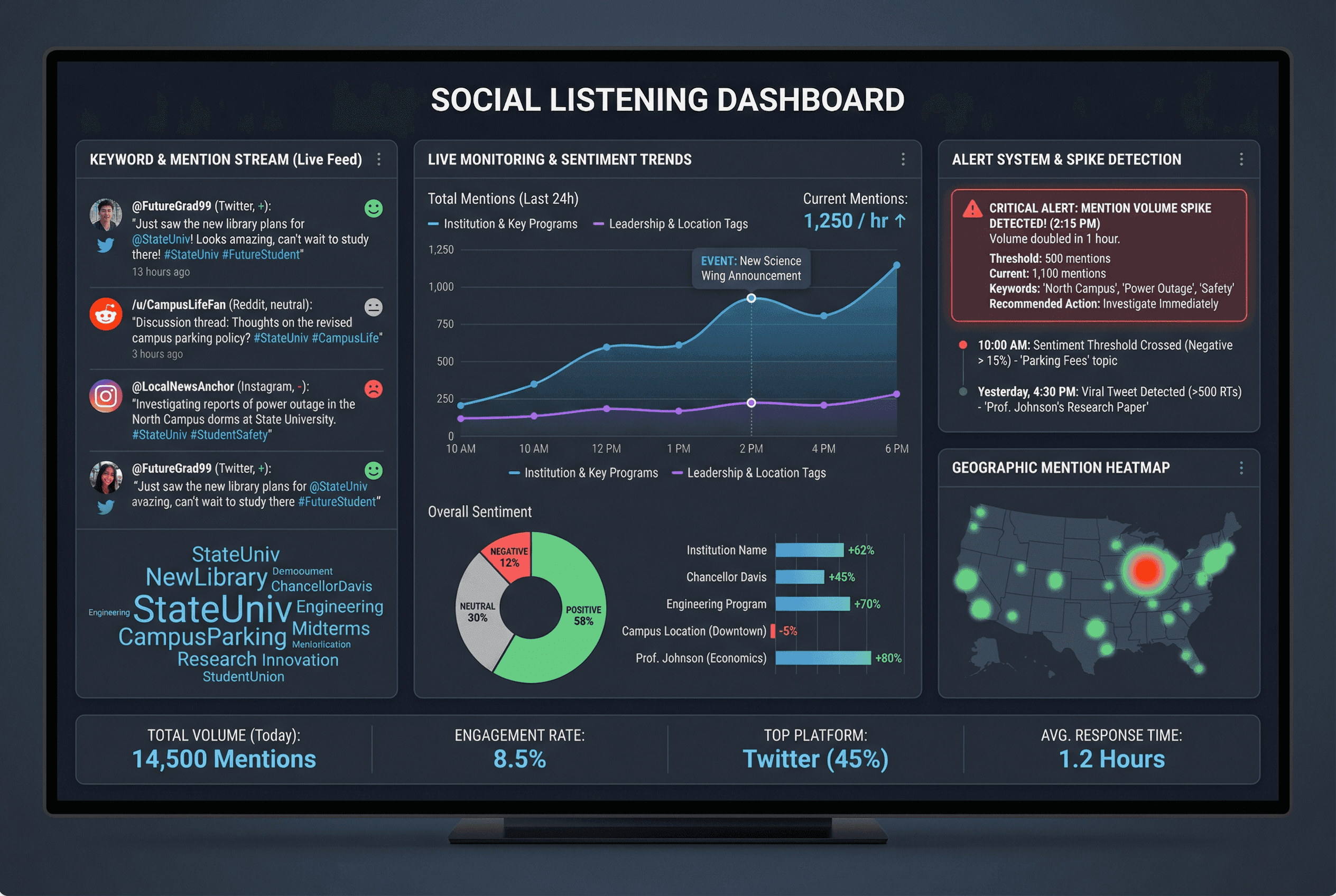
Set up a live monitoring dashboard using tools like Brandwatch, Sprout Social, or even a well-configured Google Alerts system.
Monitor your institution's name, key program names, your campus location tags, your Chancellor or President's name, and your most prominent faculty. Track not just direct mentions but sentiment – are the conversations positive, neutral, or trending negative?
The dashboard should be checked daily by one designated team member. But more importantly, configure spike alerts. If your mention volume doubles in a two-hour window or negative sentiment crosses a threshold, you want a notification immediately.
Speed of awareness is your first line of defense. The earlier you know something is building, the more options you have. A concern caught at 50 tweets is manageable. The same concern at 50,000 impressions requires a very different response.
🔹 Build a Three-Tier Content Approval System
Not every post carries the same risk. Treating them all the same creates two problems:
- safe content gets slowed down by unnecessary approval layers, and
- sensitive content gets waved through by someone who shouldn't be making that call alone.
Design a three-tier system based on risk level.
Tier 1 covers routine content – student features, event coverage, program highlights. The social media manager approves and posts. No escalation needed. This is 80% of your content and should move fast.
Tier 2 covers sensitive topics – tuition announcements, policy changes, responses to campus incidents, anything touching mental health, diversity, or financial aid. This requires sign-off from a Director or Head of Communications before it goes live.
Tier 3 is full crisis mode – student safety incidents, viral controversies, national news involvement, legal exposure. At this level, the VP of Communications and likely the President or Chancellor need to be looped in before anything is posted. A pre-agreed escalation contact list with personal phone numbers (not just work emails) is essential here.
Map this system out. Print it. Make sure everyone on the team knows exactly which tier any given piece of content falls into and who holds approval authority. Ambiguity in a crisis is catastrophic.
🔹 Pre-Write Your Crisis Playbook Before the Crisis
The worst time to write a crisis response is during a crisis. Under pressure, with senior stakeholders demanding action, with journalists calling for comment, and with Twitter evolving in real time – the quality of your thinking collapses. You need to be executing a plan, not creating one.
Build a Crisis Response Playbook in advance. It should contain pre-drafted holding statements for your most likely scenarios:
- a student safety incident on campus
- a controversial speaker or event
- a staff or faculty conduct allegation
- a data breach
- a protest or campus disruption
- a national news story that implicates your institution
The responses aren’t copy-paste, these are frameworks and structures that are pre-approved. The tone is pre-agreed, the key messages are already cleared by legal and leadership. This means when the moment arrives, your team is filling in specifics not negotiating tone with six stakeholders in real time.
Each scenario in your playbook should also include:
- who gets notified first
- who holds posting authority
- which platforms need a response
- whether a press statement is required in addition to social
- what the 24-hour and 72-hour follow-up cadence looks like
Run a tabletop exercise with your communications team once a year. Pick a realistic scenario, walk through the playbook, find the gaps, and update accordingly.
🔹 The Dark Mode Protocol – When to Go Silent and When to Speak
Sometimes the right social media decision is to stop posting entirely. And knowing when to make that call is one of the most important crisis skills a communications team can develop.
When a serious incident occurs on campus like a student death, a significant safety event, a community trauma – continuing to post scheduled content while the community is grieving is brand-damaging in ways that are difficult to recover from. Audiences don't forget the university that posted a cheerful campus photo the same afternoon a tragedy was unfolding.
Define your Dark Mode criteria in advance.
- What types of events trigger an immediate content pause?
- Who has the authority to call it?
- What's the minimum pause period?
- What does the first post after a Dark Mode period look like and who approves it?
The return from Dark Mode is as important as the decision to enter it. Coming back too quickly feels tone-deaf. Coming back with the wrong content feels exploitative. Your playbook should include a return framework → a genuine acknowledgment of what happened, a signal of what actions are being taken, and a quiet re-entry into regular content cadence that doesn't feel jarring.
#12 – Data-Driven A/B Testing & Optimization
🔹 UTM Tag Everything, Without Exception
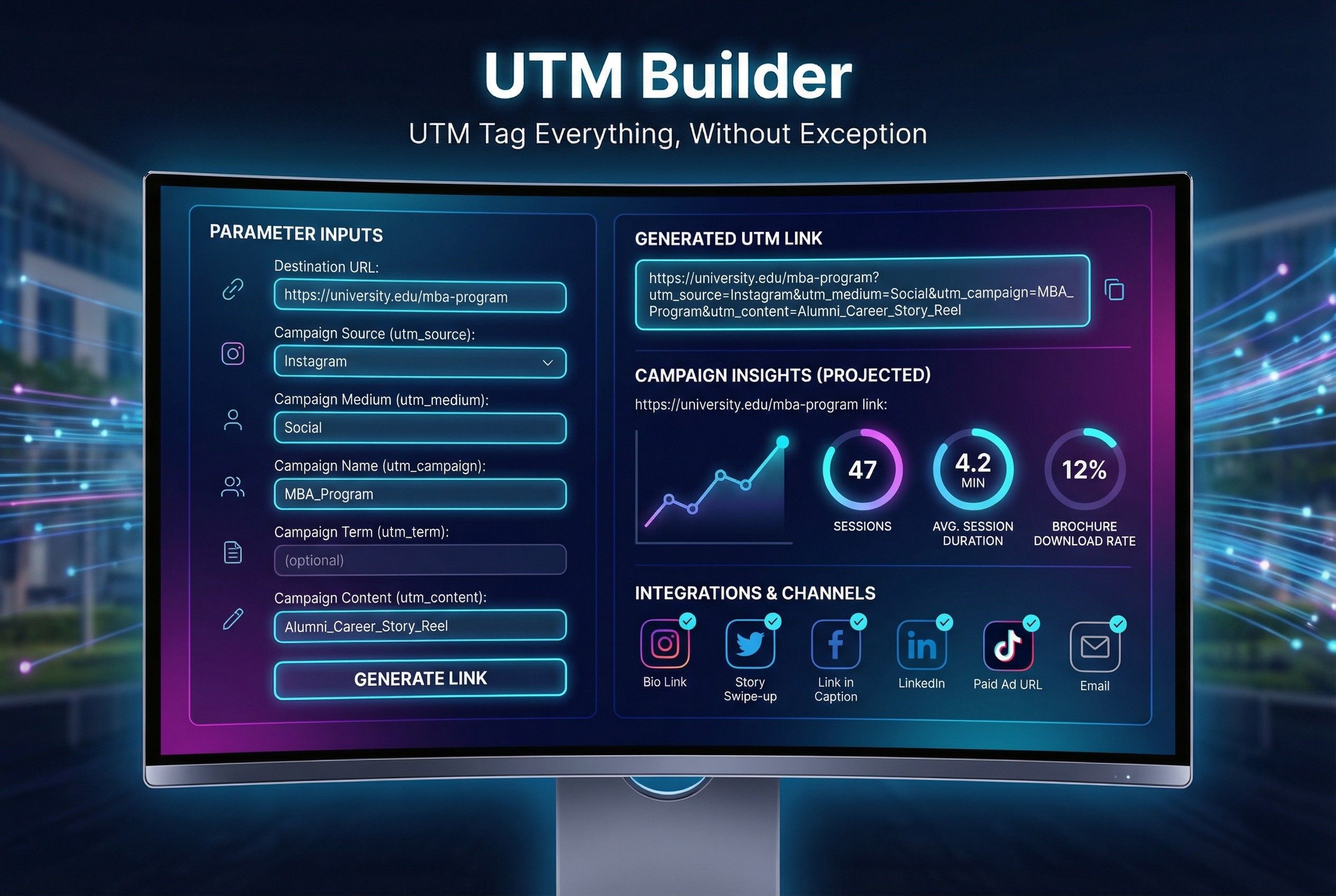
You cannot optimize what you cannot trace. And right now, most colleges have no idea which specific piece of content drove a prospective student to their application page.
Fix this by implementing UTM parameters on every single link that shows up on your social channels – bio link, Story swipe-up, link in caption, paid ad URL and so on.
Each link should be tagged with the platform it came from, the content type, the campaign name, and the specific post.
The level of insight you get → this specific alumni career story Reel on Instagram drove 47 sessions to the MBA program page, with a 4.2 minute average session duration and a 12% brochure download rate.
You can use Google’s official UTM Builder.
🔹 Stack Your Analytics – Don't Rely on Native Insights Alone
Every platform's native analytics is designed to make that platform look good. Instagram wants you to believe Instagram is working. LinkedIn wants you to believe LinkedIn is driving results. None of them are designed to show you the full picture.
Build a stacked analytics system that layers three data sources.
- Native platform insights give you content-level performance – reach, saves, shares, follower growth, story completion rates.
- A third-party tool like Sprout Social or Hootsuite gives you cross-platform comparison and trend data that native tools don't offer.
- Google Analytics gives you the ground truth – what actually happened after someone left social media and landed on your website.
The gap between platform-reported performance and Google Analytics is often significant.
A platform might report 5,000 link clicks. Google Analytics shows 800 sessions. That discrepancy tells you something important about content-to-page conversion, you want to reduce it. But you'd never know that gap existed if you were only looking at native analytics.
🔹 Build a Systematic Creative Testing Framework
For every significant campaign, isolate three variables and test them one at a time.
- The hook: the first 3 seconds of a video or the first line of a caption – has the largest single impact on performance and should be tested first.
- The visual format: talking head vs. text overlay vs. B-roll montage – affects completion rate and saves differently depending on your audience and platform.
- The call to action: "apply now" vs. "download the guide" vs. "watch the full story" – directly affects conversion behavior.
Run each variation to a minimum of 1,000 impressions before drawing conclusions. Anything below that is noise dressed up as signal.
Document your test, your hypothesis, your result, and your takeaway in a shared log that your whole team can learn from. Over time this log becomes one of your most valuable institutional assets – a tested, evidence-based understanding of what your audience responds to that no competitor can replicate.
What You Need To Remember
Ask yourself this question → If your university went dark on social media for 90 days – stopped posting entirely – would enrollment actually drop?
For most institutions, the uncomfortable answer is: probably not much.
Not because social media doesn't matter. It does, enormously. But because the social media most universities are doing isn't connected to enrollment in any measurable way. It's content for the sake of content. Activity mistaken for strategy.
The strategies and frameworks in this guide exist to fix that disconnect.
You don't need to implement all 11 strategies tomorrow.
In fact, trying to do so is the fastest way to implement none of them well.
Instead, here are five things you can start this week that will show results within 30 days – no budget approval required, no new hires needed.
This Week's Starter Playbook
- UTM tag your bio link right now. It takes 10 minutes and immediately starts telling you which content is actually driving website traffic. Set it up, and check back in two weeks. You'll be surprised what you find.
- Screenshot the last 50 comments on your top three posts. Read them properly. You'll find at least three content ideas, two recurring objections you haven't addressed, and one comment worth featuring in a carousel. That's your next week of content decided.
- Identify your top five performing posts from the last 90 days by saves and shares not likes. Look for the pattern. There is always a pattern. Build your next month's content around it.
- Set up a Google Alert for your university name, your top competitor's name, and three industry keywords relevant to your most enrolled programs. It takes five minutes and gives you a daily newsjacking feed.
- DM five of your most engaged student followers today and ask if they'd be interested in a social media training program. You're planting the seed for your ambassador program before you've formally launched it.
None of these require sign-off from a committee.
None require a new tool subscription.
They just require someone on your team deciding to start.
The honest question now is → do you have the internal capacity to build this, or do you need a partner who's already done it?
We work with universities to implement AI-driven social media systems – content infrastructure, data architecture, ambassador program design, paid funnel strategy – built specifically around enrollment outcomes.
Not content for content's sake. Not vanity metrics dressed up in a monthly report. Systems that drive applications.
If that conversation is worth having, we're ready to have it.